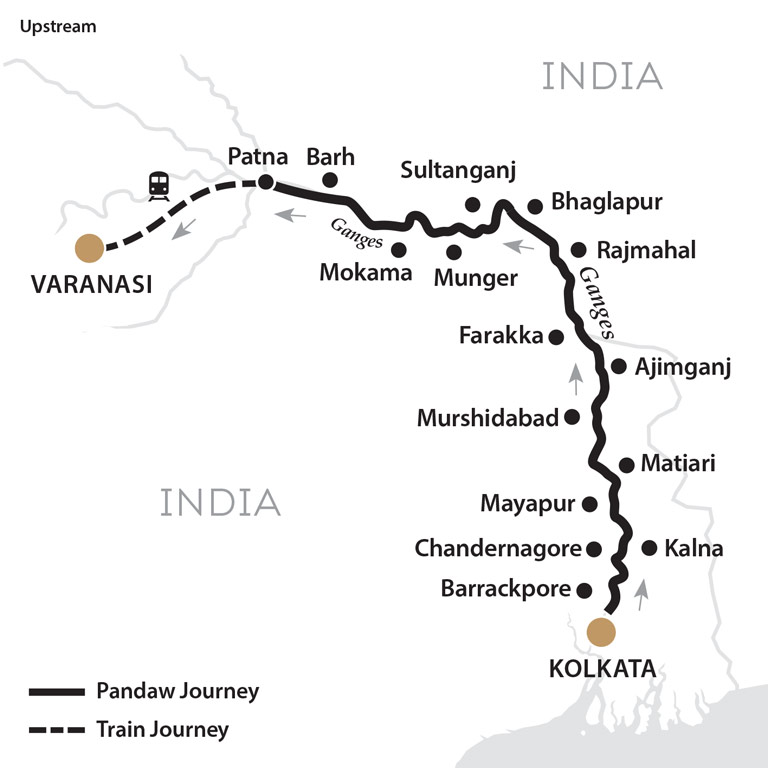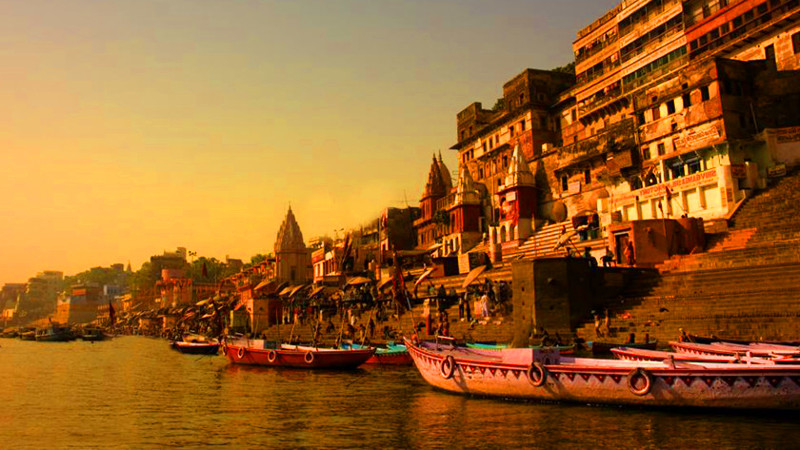
Varanasi, said to be the oldest inhabited city on the planet, is the most sacred city of Hinduism and a place of overwhelming beauty at the same time poignantly moving with its cremation ghats. Varanasi is surely the goal of any 'passage to India' and at the other end of the holy river stands Kolkata, in all its Raj-like magnificence. Between lies several of the most important Buddhist sites in the country, fascinating cities great and small as well as expanses of empty river teeming with bird life, not to mention the Gangeatic dolphin.
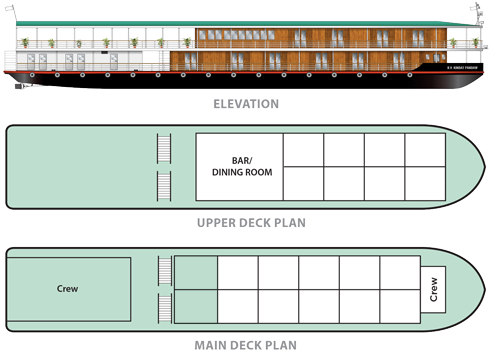
No vessel could be more appropriate for a trip down this special river than our ultra shallow draft Pandaw K class ships.
Important Notice: The cruise schedule includes the latest information regarding your program, but last minute adjustments may occur. The schedule may shift due to the weather or to take advantage of unexpected opportunities. The exact time for each activity will be announced or posted by the onboard tour staff.
From September 2024, Pandaw is happy to announce that our India expeditions will be all-inclusive, with complimentary local beers, spirits, mixers and soft drinks for all guests. Also included free of charge is select house wines during lunch and dinner only. Subject to availability.
Please Note: The Upper Ganges segment of this itinerary passes through the state of Bihar. In this state it is illegal to serve any drinks containing alcohol. For this reason, we will not be able to serve alcohol onboard the ship.
Day 1 - Kolkata - Barrackpore
Transfer from your hotel or airport in Kolkata to embark and sail at noon. Sail past the old Danish colony of Serampore to Barrackpore to land and take a walk through the cantonment - past the Semaphore Tower, Government House, the Temple of Fame and Flagstaff House.
Day 2 - Chandenagore
Continue sailing upstream to Chandernagore, a French possession until 1950. Visit the 18th century church and Dupleix’s House, erstwhile Governor-General of French India.
Day 3 - Kalna
After breakfast sail upstream and land at the country town of Kalna and take rickshaws to see a group of some of Bengal’s most attractive terracotta temples, as well as the unique Shiva temple with concentric rings made up of 108 lesser shrines. Sail on through the night to a mooring near Matiari.
Day 4 - Mayapur
Explore the village of Mayapur, the headquarters of the ISKCON movement with a new temple comparable in size to the Vatican and largely funded by Alfred B. Ford, the great grandson of car maker Henry Ford. Meet Krishna followers and walk through the pilgrims’ bazaar.
Day 5 - Matiari
Visit the brass-working village of Matiari, a charming riverside village. Interact with the locals of Matiari and witness the whole primitive process of beating out brass water pots and other vessels. Continue cruising upstream and time permitting visit the battlefield of Plassey where, in 1757, Robert Clive, the Commander-in-Chief of British India, defeated Siraj-ud-Daulah, the last independent Nawab of Bengal, to change the course of Indian history. Moor close to Murshidabad for the night.
Day 6 - Murshidabad
This morning, walk to the Khushbagh, a peaceful Mughal-style garden that encloses the tombs of Siraj-ud-Daulah – the last independent Nawab of Bengal – and his family. Continue a little way upstream to where the great Hazarduari Palace dominates the waterfront. Built by an English architect in 1837, the palace hosts an extensive collection of pictures, china, weapons and other objects. Carry on to visit the great Katra Mosque and Nashipara Palace before driving out to see the Katgola Palace. Built in classical Georgian style by rich local merchants, Katgola Palace represents the other side of the coin of the 'White Mughal' period when English and Indian cultures came close to fusion. Moor overnight on the riverbank across from town.
Day 7 - Ajimganj - Farakka
Continue up the Hoogly which transforms into a charming waterway twisting and turning between banks lined with mustard fields and mango orchards. Morning walk through the fields of the delightfully sleepy village of Baranagar to visit its three gorgeous miniature terracotta temples. This is rural India at its most idyllic. Visit the Jain temples at Azimganj before continuing on to the Farakka Barrage.
Day 8 - Farakka - Rajmahal
Today pass through the Farraka Barrage onto the Ganges proper. In the afternoon we explore the quaint town of Rajmahal.
Day 9 - Sailing
We sail up the mighty Ganges river toward the confluence with the Koshi river. Stop along the way for a short village walk and enjoy our onboard entertainment.
Day 10 - Bhaglapur – Sultanganj
We sail early morning toward Bhaglapur, a hub of silk production. We witness the silk weaving and explore this small town before returning to the ship for lunch. In the afternoon we visit Sultanganj with its pair of great granite rocks, one crowned with a mosque and the other a small temple dating from the 16th century.
Day 11 - Munger
Munger is now a large and industrialised city but has an interesting history. In 1762, Mir Qasim, the Nawab of Bengal, shifted his capital from Murshidabad to Munger, and established a firearms manufacturing centre here. Explore the Mughal fort, East India Company cemetery and step inside the Bihar School of Yoga founded in 1964 by Satyananda Saraswati. One of the leading yoga schools in the country. The institution has developed yogic techniques through a synthesis of traditional yogic, vedantic and tantric practices and contemporary health science.
Day 12 - Mokama
Stop at Mokama, once home to Jim Corbett the naturalist and protector of the Indian tigers. Surrounded by farmlands, Mokama has the second hightest production of lentils in the country. Learn about the freedom fighters from Mokama such as Lalldin Saheb, whose during the freedom struggle was sentenced to jail during the British rule.
Day 13 - Barh
Explore Barh, a town famous for Hindu ritual cremation at Urmanath and the Alakhnath Temple.
Day 14 - Patna
Enjoy a city tour of Patna, capital of Bihar state including a visit to The Golghar, a large stupa styled granary built in 1786. Farewell dinner with your crew.
Day 15 - Patna To Varanasi
Disembark your Pandaw vessel ready and transfer to Patna station for your 1st class train to Varanasi. Upon arrival to Varanasi, transfer to your hotel or the airport.
Please note if you have not booked a post cruise extension with Pandaw all services will end upon transfer to your hotel in Varanasi or Patna. If you have booked a post cruise extension with Pandaw your flight will be booked from Patna and not Varanasi unless specifically requested.
Day 1 - Varanasi To Patna
Depart Varanasi in the morning and head to the train station for your journey to Patna where we meet your Pandaw vessel. Relax onboard and meet your crew and fellow passengers for the next 14 nights.
Day 2 - Barh
Morning city tour of Patna including a visit to The Golghar, a large stupa styled granary built in 1786. Sail downstream during lunch before arriving to Barh, a town famous for Hindu ritual cremation at Urmanath and the Alakhnath Temple.
Day 3 - Mokama
Stop at Mokama, once home to Jim Corbett the naturalist and protector of the Indian tigers. Surrounded by farmlands, Mokama has the second hightest production of lentils in the country. Learn about the freedom fighters from Mokama such as Lalldin Saheb, whose during the freedom struggle was sentenced to jail during the British rule.
Day 4 - Munger
Munger is now a large and industrialised city but has an interesting history. In 1762, Mir Qasim, the Nawab of Bengal, shifted his capital from Murshidabad to Munger, and established a firearms manufacturing centre here. Explore the Mughal fort, East India Company cemetery and step inside the Bihar School of Yoga founded in 1964 by Satyananda Saraswati. One of the leading yoga schools in the country. The institution has developed yogic techniques through a synthesis of traditional yogic, vedantic and tantric practices and contemporary health science.
Day 5 - Sultanganj
Continue to Jahanigra Island, a place of pilgrimage with many rock carvings in high relief dating from the eighth century depicting aspects of Siva and Vishnu. In the evening moor off Sultanganj, with its pair of great granite rocks, one crowned with a mosque and the other a small temple dating from the 16th century. In the afternoon land at Bhaglapur, a centre of silk production, and visit the 18th century mansion of the Collector, Augustus Cleveland.
Day 6 - Bateshwarstan
Passing the confluence of the Kosi river that flows down from Nepal, moor at the pretty town of Bateshwarsthan to uncover the 8th century Buddhist site of Vikramshila, one of the two most important centres of learning in India during the Pala Empire, along with Nalanda.
Day 7 - Farakka
Continue sailing along the Ganges before stopping at Rajmahal, a quaint town on the banks of the Ganges for an afternoon walk.
Day 8 - Farakka Barrage
Depart Rajmahal and sail down to cross the Farakka barrage, entering the Hooghly River. In the afternoon take a gentle walk through a local village.
Day 9 - Murshidabad
After breakfast, take a walk through the fields of the delightfully sleepy village of Baranagar to visit its three gorgeous miniature terracotta temples. This is rural India at its most idyllic. Visit the Jain temples at Azimganj before continuing our voyage downstream. In the afternoon we enjoy a city tour of Murshidabad, visiting the great Katra Mosque and Nashipara Palace before driving out to see the Katgola Palace. Built in classical Georgian style by rich local merchants, Katgola Palace represents the other side of the coin of the 'White Mughal' period when English and Indian cultures came close to fusion.
Day 10 - Kushbagh
This morning, walk to the Khushbagh, a peaceful Mughal-style garden that encloses the tombs of Siraj-ud-Daulah – the last independent Nawab of Bengal – and his family. Continue a little way upstream to where the great Hazarduari Palace dominates the waterfront. Built by an English architect in 1837, the palace hosts an extensive collection of pictures, china, weapons and other objects. Continue sailing downstream in the afternoon with onboard activities and wildlife watching on the sun deck.
Day 11 - Matiari
In the morning we visit the battlefield of Plassey where, in 1757, Robert Clive, the Commander-in-Chief of British India, defeated Siraj-ud-Daulah, the last independent Nawab of Bengal, to change the course of Indian history. After lunch we continue downstream to the brass-working village of Matiari, a charming riverside village. Interact with the locals of Matiari and witness the whole primitive process of beating out brass water pots and other vessels.
Day 12 - Mayapur
Explore the village of Mayapur, the headquarters of the ISKCON movement with a new temple comparable in size to the Vatican and largely funded by Alfred B. Ford, the great grandson of car maker Henry Ford. Meet Krishna followers and walk through the pilgrims’ bazaar.
Day 13 - Kalna
After breakfast visit the country town of Kalna. Take rickshaws to see a group of some of Bengal’s most attractive terracotta temples, as well as the unique Shiva temple with concentric rings made up of 108 lesser shrines.
Day 14 - Chandenagore
Continue sailing upstream to Chandernagore, a French possession until 1950. Visit the 18th century church and Dupleix’s House, erstwhile Governor-General of French India. In the afternoon we sail toward Barrackpore and take a walk through the cantonment - past the Semaphore Tower, Government House, the Temple of Fame and Flagstaff House. Enjoy a farewell dinner with your crew as we moor in Kolkata for the night.
Day 15 - Disembark Kolkata
After breakfast transfer to your hotel or airport for your onward journey.
Cruise Price Includes: Transfer to/from Ship including one way 1st class train ticket, entrance fees, guide services (English language), gratuities to crew, main meals, local mineral water, jugged coffee, teas & tisanes plus our India complimentary drinks package
Price Excludes: International flights, laundry, all visa costs, fuel surcharges (see terms and conditions), all beverages except local mineral water, jugged coffee, teas & tisanes, tipping for guide and drivers.
Please Note:
Weather Condition Warning
River cruising on the Lower and Upper Ganges can be severely affected by fog during the months of December and January. This may impact the sailing schedules and the planned excursions. While every effort will be made to make up time and include all activities this is not always possible. Similarly temperatures can drop significantly overnight and in the early mornings, though during the day warmer temperatures can be expected. Winter temperatures can be below average with many destinations in Bihar and Uttar Pradesh experiencing long spells of cold.
All bookings are subject to availability
Very Important : Before booking be sure you read our Terms and Deposit section for important information.